India’s banking sector is facing an unprecedented wave of cyberattacks in 2025. From phishing scams targeting customers to sophisticated ransomware campaigns against core banking infrastructure, the financial industry is under pressure like never before. Recent data from the Reserve Bank of India (RBI) and government agencies suggests that both the scale and sophistication of these cyberattacks have increased significantly this year.
1. The Alarming Numbers
According to the Reserve Bank of India (RBI), reported cyber fraud cases in the banking sector jumped by nearly 40% in the first half of 2025 compared to the same period in 2024. The Indian Computer Emergency Response Team (CERT-In) has also issued multiple advisories warning banks about targeted ransomware and phishing campaigns that exploit both human and technical vulnerabilities.
Private and public sector banks alike are being affected, and no institution is truly immune. In some cases, attackers are bypassing traditional defenses by exploiting vulnerabilities in third-party vendors or unsecured remote access systems.
2. Why Are Banks Being Targeted?
Banks remain the most lucrative targets for cybercriminals because they sit at the center of money movement. In 2025, attackers are also finding success because of the rapid digital transformation in banking. With the surge in Unified Payments Interface (UPI) transactions, online loan approvals, and AI-driven financial services, attackers now have a wider digital surface to exploit.
Cybercriminal groups are leveraging tactics like:
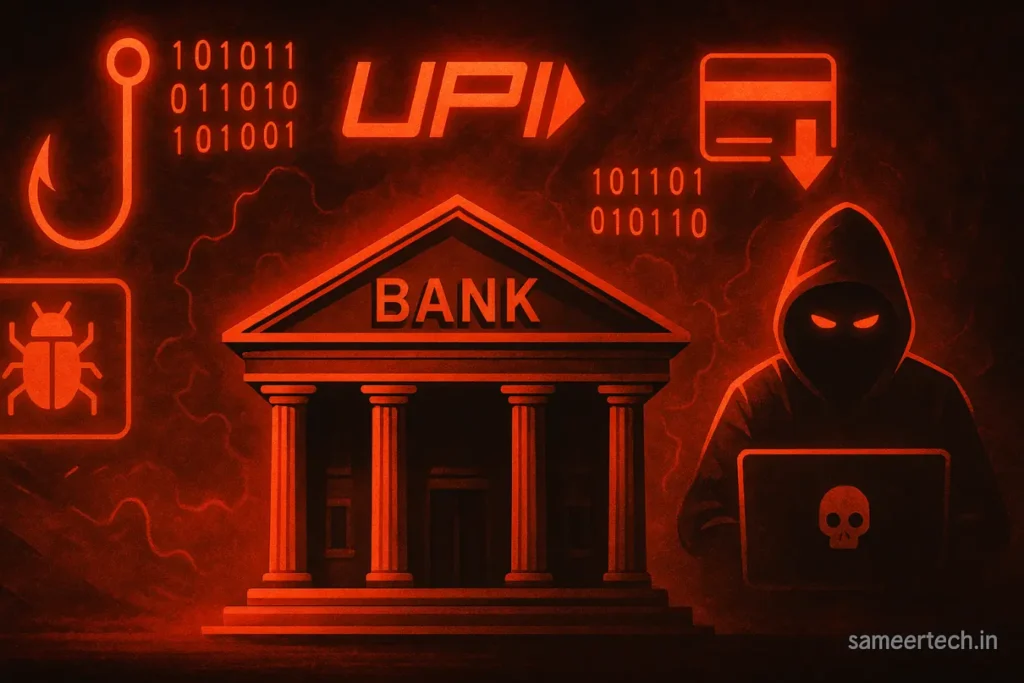
- Phishing & Smishing: Fake SMS and emails luring customers to share OTPs or click on malicious links.
- Ransomware: Attacks on core banking IT systems that demand huge payments in cryptocurrency.
- Supply Chain Exploits: Targeting third-party fintech providers that integrate with banks.
- Social Engineering: Manipulating customer service representatives or bank staff into revealing sensitive details.
3. Real-World Cases Making Headlines
In March 2025, a leading private bank reported a ransomware incident that temporarily disrupted mobile banking services for thousands of customers. Around the same time, multiple cooperative banks in Maharashtra and Gujarat fell victim to phishing scams where customers lost crores through fraudulent UPI transactions (Economic Times).
Earlier this year, CERT-In also confirmed that at least two Indian banks had been targeted by a suspected foreign cybercrime group using advanced malware to exfiltrate sensitive financial data (Indian Express).
4. The Human Side of the Problem
While banks are investing heavily in firewalls, intrusion detection, and AI-driven fraud monitoring, a large portion of cyberattacks still succeed because of human error. A misplaced click on a phishing link, an employee using a weak password, or customers sharing OTPs unknowingly — all of these open the door for criminals.
Cybersecurity experts stress that awareness and training are just as important as deploying cutting-edge tools. Unfortunately, in smaller cooperative banks and rural areas, awareness levels among customers remain low, making them easy prey for fraudsters.
📌 Read More
5. How Are Banks Responding?
In response to the growing threat, the RBI has instructed banks to conduct frequent cybersecurity audits and enhance incident response capabilities. Some banks are also adopting zero-trust security frameworks, where no device or user is trusted by default, reducing the risk of insider and supply-chain attacks.
Meanwhile, many financial institutions are working with cybersecurity firms to monitor dark web activity, looking for stolen customer data or credentials being traded online. UPI providers are also rolling out additional authentication layers to minimize fraudulent transactions.
6. What Can Customers Do?
Customers play a vital role in strengthening the security chain. Simple steps can go a long way in reducing risks:
- Never share OTPs, PINs, or passwords — even with someone claiming to be from the bank.
- Be cautious of links in SMS and emails that look urgent or suspicious.
- Enable multi-factor authentication wherever possible.
- Regularly update mobile banking apps and operating systems.
7. Why This Matters for India’s Future
India’s digital economy is growing at breakneck speed, and banks form the backbone of this growth. A surge in cyberattacks not only threatens financial stability but also risks eroding public trust in digital payments. For a country that prides itself on being a fintech leader, ensuring strong banking cybersecurity is no longer optional — it’s essential for long-term growth and stability.
Conclusion
The surge in cyberattacks on Indian banks in 2025 should serve as a wake-up call. With attackers getting smarter and the stakes getting higher, the combined effort of regulators, banks, cybersecurity experts, and customers will be needed to keep India’s financial system secure.